TribalDAOs Blueprint
Introduction
What we know about traditional models of tribal organisations
For as long as we can remember (some evidence dating as early as 5000BC) indigenous peoples have banded together and developed social systems for living and surviving together for their collective benefit (Ronfeldt. 1996). While each group structure and system differed, reflecting their unique cultural, social, and environmental contexts, these groups also often shared many similarities. These kinship groups were formed on the basis of shared ancestors, growing from small family units into larger clans or tribes. They lived completely autonomously, developing their own codes of conduct and economies within a mostly egalitarian society, supported by community and spiritual leadership.
How tribal organisations have evolved to current models of organisation
In modern times the impacts of colonisation, capitalism and technology have had a major influence on the systems that indigenous communities have developed and how they are structured and organised.
Many nations have developed many different types of "registered entities" with their elected boards in order to fit within the legal context of the dominant colonial systems. Table 1 shows the different types of Māori organisations and institutions established that have been establised in Aotearoa NZ and the impact that legislation has on these organisations.
Table 1: Maori Trusts and Incorporations: How Government Legislation affects Sustainable Economic Development
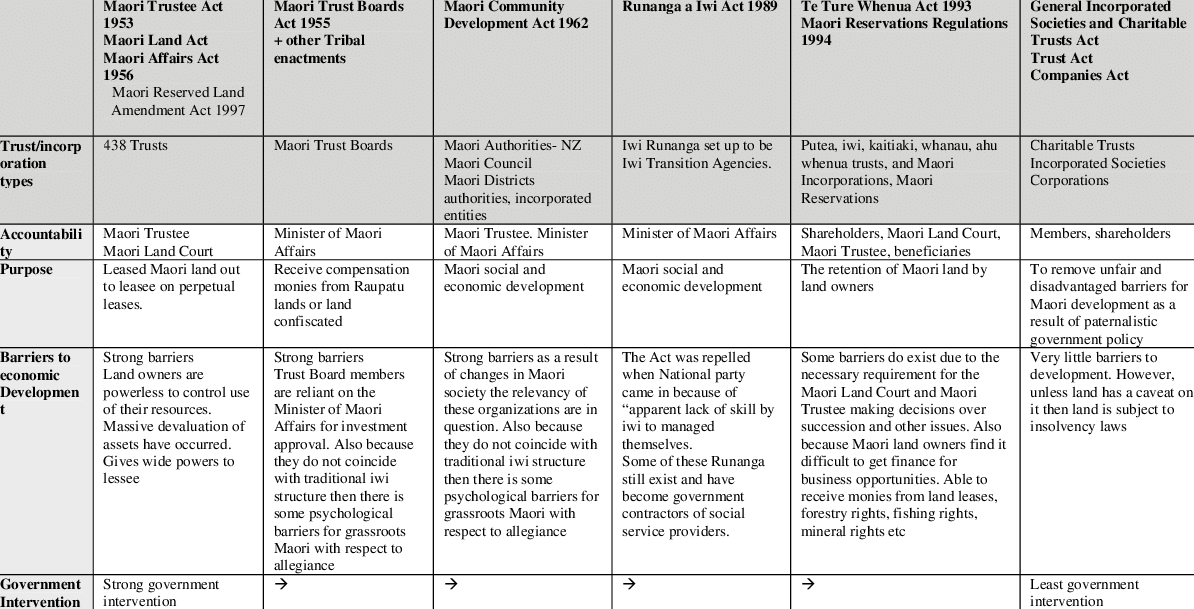
(source: Scrimgeour. 2011)
And while some Indigenous nations have managed to maintain elements of autonomy and self-governance either in practise or in law, (Joseph. 2014) there are many that no longer have this right within their own territories.
Their economies and resources have been redefined by an introduced currency from an invaded state, and an ungovernable market of private enterprises that often have conflicting values.
Challenges with the current models
The development of organisational structures for Indigenous communities within the imposed legal and economic frameworks have created administrative processes and financial values placing decision-making power in the hands of a few individuals and reducing the community organisations ability to respond to community needs (Rata, 2011). Additionally, financial dependency on government funding, grants, and external institutions limits economic sovereignty, making it difficult for communities to sustain long-term initiatives without outside approval or intervention (Paora et al, 2011).
Another major challenge is the dispersed nature of Indigenous populations, with many members living in urban areas or outside their ancestral lands. This diaspora population face challenges connecting to governance and decision-making processes, leading to limited community participation and reduced engagement in local initiatives. Additionally, historical injustices and past experiences of mismanagement have led to a lack of trust and transparency within governance structures, where decisions are often made without broad community input or clear mechanisms for accountability (Rata, 2011).
These challenges create barriers to sustainable development and prevent Indigenous groups from implementing governance models that truly reflect their cultural values and aspirations.
LLC's, NGO's, NFP's and now DAO's
What is a DAO? (Decentralized Autonomous Organization)
A DAO is just another acronym to describe a way of structuring human organisation towards a common purpose. The acronym stands for Decentralized Autonomous Organization which essentially means that it operates without a central authority. Instead of a CEO or board making decisions, a DAO is governed by a community of token holders who vote on proposals. A DAO makes it transparent, community-driven, and decentralized.
Key Features of a DAO
- Decentralized Governance
- No single leader—decisions are made collectively by members.
- Members vote on proposals using governance tokens.
- Smart Contracts for Automation
- Rules are coded into smart contracts that execute automatically.
- Example: If the community votes to fund a project, the smart contract automatically transfers funds.
- Token-Based Economy
- Members earn tokens through participation and contribution
- Tokens can be used for decision making and exchanged for ecosystem resources or external currencies
- Transparent & Trustless
- Everything (votes, transactions, rules) is recorded on the blockchain.
- This reduces the need for intermediaries—reducing corruption and inefficiencies.
- Community-Driven Treasury
- The DAO manages its funds in a collective treasury.
- Funds are distributed only through democratic voting.
Benefits of a DAO
✔ Community-Led Governance – No central authority controlling decisions.
✔ Transparent & Accountable – All transactions and votes are on-chain.
✔ Global & Borderless – People from anywhere can participate.
✔ Autonomous – Smart contracts enforce the rules, reducing human bias.
✔ Efficient Resource Management – Funds are distributed fairly and democratically.
Challenges of a DAO
⚠️ Regulatory Uncertainty – Some governments don't recognize DAOs as legal entities.
⚠️ Security Risks – Smart contract bugs can be exploited.
⚠️ Voter Apathy – Low participation can centralize decision-making.
⚠️ Onboarding & Education – Members need to understand blockchain and governance.
Examples of Successful DAOs
🔹 Cardano Catalyst – Funds blockchain projects via community voting.
🔹 Gitcoin DAO – Distributes grants for open-source development.
🔹 Uniswap DAO – Governs the Uniswap decentralized exchange.
🔹 Bankless DAO – A decentralized media and education network.
USD, NZD and now BTC
What is Tokenomics?
Tokenomics (Token Economics) refers to the design, distribution, and management of digital tokens within a blockchain ecosystem. Ultimately it defines what a community values, but specifically it defines how a token is created, how it gains value, and how it incentivizes behavior within a decentralized system. Tokenomics includes factors such as supply mechanisms, utility, governance, incentives, and distribution models, all of which determine how tokens function within an economy. A well-designed tokenomics model ensures that tokens serve a meaningful purpose, maintain value, and contribute to the sustainability of the community.
In practice, tokenomics can be used to reward participation, encourage governance, provide liquidity, and sustain community-driven projects. Tokens can act as a medium of exchange, a store of value, or a governance tool that grants holders decision-making power within a community.
Key features of Tokenomics
DAOs (Decentralized Autonomous Organizations) rely on tokenomics to govern decision-making, incentivize participation, and sustain economic activities within a decentralized community. Tokens in a DAO can be used in several key ways:
- Governance & Decision-Making
- DAO members use governance tokens to vote on proposals, allocate resources, and shape policies.
- The more engaged members are, the greater their voting power (e.g., staking tokens for governance rights).
- Incentivizing Participation & Contributions
- Members can earn tokens by contributing to the DAO (e.g., participating in governance, completing tasks, or supporting community initiatives).
- Example: A Tribal DAO could reward members for land stewardship, cultural preservation, or knowledge sharing.
- Sustaining Economic Activity
- Tokenomics allows DAOs to create self-sustaining digital economies by issuing and managing tokens that represent value within the system.
- Example: A Tribal DAO's token could be used for community trade, services, or revenue-sharing.
- Financial Independence & Treasury Management
- DAOs use treasury-backed tokens to fund community initiatives and allocate resources transparently.
- Example: A Tribal DAO could collect transaction fees from its marketplace, using the revenue to fund education, housing, or environmental projects.
- Building Sustainable Local Economies
- Tokenomics allows Indigenous communities to develop local economies that are not fully dependent on external funding.
- Members can exchange goods, services, and labor using their own digital currency.
In essence, DAOs and tokenomics work together to create decentralized governance and self-sustaining communities, offering new ways for Indigenous communities to manage resources, incentivize participation, and achieve economic sovereignty.
Benefits of Tokenomics for DAOs
✔ Local Designed Systems – Governance and economic models are designed to match traditional practises and local context.
✔ Incentivized Participation – Engagement and participation is rewarded.
✔ Transparent & Trustless Transactions – Blockchain transparency reduces fraud and mismanagemet.
✔ Sustainable Funding – New revenue generating opportunities based on community activities and resources.
✔ Economic Sovereignty – Communities can control their own digital economy, reducing dependency on state or corporate financial systems.
Challenges of Tokenomics for DAOs
⚠️ Regulatory Uncertainty – Unclear legal frameworks create potential compliance risks.
⚠️ Complexity & Accessibility – Understanding blockchain, wallets, and tokenomics can be a barrier for non-technical community members.
⚠️ Low Adoption & Liquidity Risks – If a token isn't widely used or lacks exchangeability, its value may remain low, limiting real-world utility.
⚠️ Security Risks & Vulnerabilities – Digital financial and governance systems require different security practises.
⚠️ Power Concentration – If governance tokens are unevenly distributed, wealthier members could centralize decision-making.
Examples of Successful Tokenomics for DAOs
🔹 Cardano Catalyst – ADA token holders vote on funding proposals for ecosystem development.
🔹 Bankless DAO (BANK Token) – Members earn BANK tokens for creating educational content and community engagement.
🔹 Gitcoin Grants (GTC Token) – Contributors earn tokens for funding or building open-source projects.
🔹 Celo (cUSD & cEUR) – A stablecoin-based economy supporting community-led financial inclusion initiatives.
🔹 KlimaDAO – Issues KLIMA tokens that are backed by carbon credits, creating a sustainable environmental funding model.
Tribes, Trusts and now Tribal DAOs
A Tribal DAO is a model for a tribal organisation that is managed digitally and enables all of its community members to engage and participate in the governance and administration of community projects and resources. By leveraging blockchain technologies, communities design governance and economic systems that are specific to their cultures, contexts, and aspirations. This provides enables groups to engage and coordinate their entire population, while growing a the communities capacity for self-governance, economic autonomy, and data sovereignty.
Key Features of a Tribal DAO
- Self-Determination & Sovereignty
- Allows Indigenous communities to create their own rules, governance systems, and decision-making frameworks without external interference.
- Can be designed to align with traditional governance models and cultural protocols.
- Smart Contracts for Governance
- Uses blockchain-based smart contracts to automate decisions, enforce rules, and distribute resources (e.g., funding, land ownership records, membership rights).
- Eliminates the need for centralized control, making governance more transparent and accountable.
- Decentralized Decision-Making
- Community members vote on proposals using a token-based or identity-based system.
- Governance models can be customized to reflect Indigenous decision-making traditions, such as consensus-based leadership or elder councils.
- Resource & Asset Management
- Manages tribal funds, digital assets and resources in a secure and transparent way.
- Could facilitate financial collaboration, the development of and revenue sharing from community enterprises, lands, or intellectual property.
- Identity & Membership Verification
- Uses decentralized identity (DID) solutions to verify and protect tribal membership, ensuring only recognized members participate in governance.
- Prevents external interference or exploitation of Indigenous identity.
- Cultural & Legal Adaptability
- Can integrate traditional laws, oral agreements, and customary governance practices.
- May interact with existing legal systems to advocate for Indigenous digital sovereignty.
Benefits of a Tribal DAO
✔ Maintains Cultural & Economic Sovereignty – Enables Indigenous communities to govern themselves without external interference.
✔ Increases Transparency & Trust – Every decision and transaction is publicly recorded, reducing corruption and mismanagement.
✔ Empowers Remote & Diaspora Members – Allows tribal members from all over the world to participate in governance and decision-making.
✔ Creates a Self-Sustaining Local Economy – Uses tokenomics to incentivize participation and reduce reliance on government funding.
✔ Efficient Resource Allocation – Smart contracts automate payments, grants, and financial management, ensuring funds go to approved projects.
Challenges & Considerations
⚠️ Technology Access: Ensuring all community members can access and use the blockchain-based system.
⚠️ Legal Recognition: Navigating interactions with national governments and legal systems.
⚠️ Adapting Traditional Governance to Blockchain: Balancing modern tech with Indigenous governance customs.
⚠️ Scalability & Adoption – A DAO needs widespread adoption within the community to function effectively.
Examples of How a Tribal DAO Might Be Used
🔹 Land Stewardship: Managing Indigenous lands using blockchain-based registries, ensuring community-controlled access and use.
🔹 Funding Distribution: Allocating funds transparently to projects like education, infrastructure, or cultural preservation.
🔹 Digital Heritage Protection: Controlling how Indigenous knowledge, language, and art are shared and monetized.
🔹 Community Decision-Making: Facilitating democratic governance through tokenised voting mechanisms.
How a Tribal DAO Operates in Practice
Step 1: Formation and Membership
- Community leaders initialise community digital infrastructure
- membership and registration system (citizenship and communications)
- rules building platform (governance and legislation)
- treasury management and tokenomics system (economy and currency)
- community engagement and participation modules (research and development)
- Community members join their TribalDAO through a mobile application and receive governance tokens.
Step 2: Rules development
- Community members collaboratively work and vote on the rules and activities that will manage the governance and Tokenomics of the DAO
- Smart contracts are generated based on rules that have been voted on and supported by the community
Step 3: Treasury and Financial Management
- Smart contracts are published on chain and initiate the creation of the Treasury and community tokens.
- Tokens are distributed and purchased by community members and stakeholders to catalyse participation and generate value for tokens and funds for the Treasury.
- The community continues to manage the Treasury, distributing funds based on the established rules.
Step 4: Community Engagement & Sustainability
- Admins setup and connect community activity Dapps (e.g storytelling, mapping, surveys, fundraising, projects, etc)
- Members participate through the connected dapp activities earning tokens funded by the Treasury (e.g contributing stories, adding to maps, completing surveys, completing project tasks)
- The local economy grows as more members and businesses accept and exchange community tokens.
- Members can exchange community tokens for national currencies for use outside of the ecosystem.
- Smart contracts ensure fair distribution of funds, token value, and transparent reporting of community contributions
Why a Tribal DAO?
A Tribal DAO creates a decentralized, transparent, and self-sustaining governance system that allows Indigenous communities to exercise sovereignty over their resources, economy, and cultural heritage. By integrating blockchain technology with traditional governance structures, DAOs can empower Indigenous peoples to control their financial and political future, reducing reliance on external institutions and ensuring that community-driven decision-making remains at the heart of governance.
Exploration and Experimentation
We plan to explore and experiment with Tribal DAOs by launching Matou DAO. It will serve as a living prototype for governance, tokenomics and digital infrastructure development. Through community-led exploration, we will test different governance models, token-based incentives, and decentralized funding mechanisms, sharing our journey along the way. By providing open-source infrastructure, technical support, and funding opportunities, Matou DAO will act as a collaborative innovation hub, allowing Tribal DAOs to co-develop, test, and refine blockchain-based governance systems that enhance autonomy, transparency, and economic sustainability.
To learn more about how Matou DAO is developing please see the Operations Manual for Matou Collective
References
Ronfeldt, David, Tribes, Institutions, Markets, Networks: A Framework About Societal Evolution. Santa Monica, CA: RAND Corporation, 1996. https://www.rand.org/pubs/papers/P7967.html. Also available in print form.
Scrimgeour, Frank & Iremonger, Catherine. (2011). Maori Sustainable Economic Development in New Zealand: Indigenous Practices for the Quadruple Bottom Line.
Joseph, Robert. (2014). Indigenous Peoples' Good Governance, Human Rights and Self-Determination in the Second Decade of the New Millennium – A Māori Perspective 2014 https://maorilawreview.co.nz/2014/12/indigenous-peoples-good-governance-human-rights-and-self-determination-in-the-second-decade-of-the-new-millennium-a-maori-perspective/
Research Process
This TribalDAOs Blueprint represents the culmination of an iterative, community-driven research process that has evolved through multiple versions (v2-v4) based on extensive consultation and real-world experimentation. The research methodology has combined academic literature review with practical community engagement, drawing on foundational works such as Ronfeldt's framework on societal evolution, Scrimgeour's analysis of Māori sustainable economic development, and Joseph's perspectives on Indigenous governance and self-determination. Key to this process has been the establishment of Matou DAO as a living prototype, enabling us to test governance models, tokenomics frameworks, and digital infrastructure in practice. The blueprint has been refined through community feedback sessions, cultural alignment workshops, and ongoing consultation with Māori communities, particularly through partnerships with the Tairea Family Trust and Whangaroa Papahapu. We extend our deepest gratitude to all contributors including Matou Collective founding members, cultural advisor Julian Rewiti, community participants, and especially the members from Tairea Family Trust and Whangaroa Papahapu whose insights and participation have been invaluable in ensuring this framework reflects authentic Māori values and community needs.